Showing posts with label food. Show all posts

Sunday, April 5, 2015

Is your kitchen clean?

Are you sure!?

Would you mind putting your finger in your kitchen sink for two seconds please?
… Congratulations! You just touched the dirtiest spot in your home, a spot that is even dirtier than your toilet!

Your kitchen might be spotless and shiny but that does not mean it is safe. Dangerous and killer invaders are living with you under the same roof, although you lock the door at night, and you do not even know it! We usually give time to clean and sanitize our bathrooms and toilets, thinking they are the dirtiest spots in the house, while our kitchens have 100,000 times more germs.

Scientifically, if you drop a piece of food in your toilet, it is safer to eat it than if it drops in your kitchen sink!


Want to know how to get rid of them?
Here is how to clean your kitchen, but first...


Meet the enemies:

Germs is the name, messing with your well-being is the game!


Our world hosts tiny invisible to the eye, living creatures that we call Germs. Once attached on your hands for instance, these germs penetrate your body through your eyes, nose and mouth. Germs intrude into your body to colonize it and live there, some are actually pacifiers and do good to your body, but the majority cause illnesses and deceases that vary from a simple diarrhea or flu, to HIV (Aids) or Virus C and other killer diseases.

The most common Germ types are virus and bacteria. They cause disease in their host (animal, plant, human or even another microorganism).


A closer look: The difference between Virus and Bacteria.

Bacteria is a single cell that need warmth and humidity to reproduce and grow. It can divide every 20 minutes and reach more than 8 million bacterial cells in 1 day. Most bacteria are killed by heat, and will fall off any surface by normal friction. Some bacteria are actually helpful to the body, others like salmonella (found in raw meat) can kill!


A virus on the other hand, is a cell with dents all around, that helps it stick to a surface. It needs a living host to reproduce (your body for instance, or a growing bacteria!). It does not die by only heat, it needs pressure as well (something that happens in special sterilizers) and it sticks to a surface harder than a bacteria, that it might not fall off by friction. Viruses are all harmful, like Influenza, chickenpox, H1N1, HIV (Aids), Virus C, Ebola, Rubella…etc.


Meet your defense: 
Macrophages is the name, Eating is the game!

A lot of the Germs passing through your mouth to your stomach are killed due to the acidic secretions of your stomach. Yet the liquids and food there, dilute the acid and it becomes not very effective.
Those who penetrate your body through your skin or eyes... pass in your blood stream though, and here is where your immunity system comes to action. It has these little fellows we call macrophages, that circulate in your white blood cells and play a 24/7 packman game in your body. They scan your body, and whenever they find an intruder, they eat it!
This little war takes time, and you can find symptoms like fever, when the fight is big!


The bad news:

The fight between your macrophages and bacteria gets harder when the enemy is in high quantity or concentration. If your immunity system is not very strong, bacteria like Salmonella can kill you!

Viruses however do not need quantity or concentration to affect you. One cell is more than enough. Once alive, in your body as its host, it reproduces.
Some mean viruses like Virus C, are not detectable to your macrophages. They pass the scan, reproduce in your liver for long years, appearing in common symptoms like those of flu, then after years, failure in your liver starts and you know the rest!


The good news:

There is a way out in 99% of the cases. Viruses and bacteria have a lifetime and favorable conditions to live in. They do not live endlessly, they die at a point when their ambient conditions are not favorable or they didn't find a host soon enough!


What you can do:

1- Regular medical checkups: (for adults with no showing symptoms)
A full medical check up every 2 years

A complete blood picture every year (that is ).

Checkups can reveal if you have a yet-hidden virus C, which will be at an early stage at this point and can easily be killed by a course of medication!
2- Limit the infection:

You can minimize the infections by following these simple cleaning AND SANITIZING rules in your kitchen (same logic will apply on the rest of the house of course).


How to have a clean and sanitized kitchen:
Cleaning and sanitizing are two different things. While cleaning whips off germs from the surface and replace them somewhere else, sanitizing however kills them!

1- Hand washing

Regular hand washing with soap and water for 20 seconds (the time it takes to sing Happy Birthday twice!). The heat of the water doesn't matter as much as the friction!


2- Sponges

They get wet and stay moist, so bacteria grow like crazy in the micro-cervices of the sponge which makes disinfection difficult. Thousands of bacteria such as E. coli and Salmonella can be present per square inch of a used kitchen sponge. Using these dirty sponges only transfers germs from one place to another. Sponges are considered No.1 source of germs in the entire house.

Pop the sponge in your dishwasher or put it wet and microwave it on high for 30 - 60 seconds. Don’t use your dishes sponge for other purposes and keep it dry.


3- Cleaning cloths

Germs also grow in the towels you use to wipe the counter tops and utensils. Wiping with dirty cloths will spread more germs, instead of removing them. So dry the towels between use and replace dishcloths every week. It is recommend to use paper towels to clean or disposable disinfectant wipes to both clean and disinfect the counters and surfaces.


4- Sink

Moisture with food particles resting for hours on dishes, now you know what that leads to. The bacteria can then easily get on your hands or spread to other foods so disinfect the sink regularly with a product made for the kitchen. Vinegar and lemon juice can clean some bacteria, but they can’t clean really bad ones. You can also use a solution of bleach and water once a day and then let the solution run down the drain. Also use baking soda and a tooth brush to clean around the drains.


5- Cutting boards

Frequently disinfect your cutting board with a kitchen disinfectant or put it in a dishwasher. Plastic cutting boards are ok, yet wooden ones seems to have a natural antimicrobial compound. Use separate cutting boards for cutting raw meat and vegetables. so you don’t get cross-contamination. 

I personally use glass plates when cutting raw meat then clean and disinfect them.


6- Fridge

Putting hot food in your refrigerator makes the temperature drop down, creating a perfect environment for the growth of bacteria. Also when you leave something open in the fridge long enough that it goes bad, it is better to clean and disinfect your fridge so any bacteria left behind, would be killed.

Clean your fridge regularly and wipe the bottom shelf every 2-3 weeks with a kitchen disinfectant as it tends to have most of the bacteria compared to the rest of your fridge, because moisture and condensation drip down from the upper shelves, or because we defrost meats above it.


7- Kitchen counter
Disinfect working surfaces before, during and after preparing meals, especially when preparing meat and poultry. Kitchen countertops tend to be the dirtiest near the sink area because people wipe them down with sponges and cleaning cloths. Don’t use sponges and cloths to clean the counter, it just spreads more germs. Use a kitchen disinfectant or a solution of 1 teaspoon of liquid unscented bleach to 1 Liter of water, and dry the countertop with disposable paper towels as they absorb a lot of moisture and bacteria then you just throw them away.

8- Other surfaces

Disinfectant sprays or wipes should be used on trash cans, door knobs, refrigerator handles, cupboard handles, faucets and stove handles, kitchen phone …etc.


9- Food handling
Keep different kinds of foods separated to avoid cross contamination (Ex: raw meat and vegetables) and similarly use separate cutting boards.
Foods should be cooked to proper temperatures to destroy bacteria and refrigerated promptly as the growth of bacteria is slowed in cold temperature.
Set your fridge to 4 degrees. Higher than that it is too hot.
Reheat cooked food to 70° C in the center for 2 minutes.
Cooking at temperatures between 70° and 100°C kills most bacteria but some spores can survive. So cool cooked foods as quickly as possible then refrigerate them.


Don’t worry, be happy!
This article is not supposed to scare you. You should not go crazy with disinfection, as your body still needs some bacteria and mild viruses from time to time, to build your immunity system database and develop it with new antibodies. Otherwise, you will become too vulnerable. That is the idea behind vaccinations for example.
Awareness however is the aim, so next time you buy soap or detergents, choose antibacterial ones and keep your safe food handling basics! 


Special thanks to Dr. Andrew Bassem ORAL & Dental Surgeon GEORGEA USA - Member of Dental German Association of Implantology DGOI, for his scientific and medical revision of the information provided.

References:

WebMD

2011 NSF International Household Germ Study
Eileen Abruzzo, director of infection control at Long Island College Hospital of Brooklyn, NY


Sunday, February 8, 2015

The Dining Etiquette Capsule

Ladies and Gentlemen,
In tribute to old school romance, the gallantry and gentlemanliness we used to see in our classic black and white movies - and which believe it or not, even the most modern women would love to have it from time to time -, I figured this refresher might help make your celebration dinners unforgettable. It will cover the important etiquette points from how to eat and dress up, to how to treat your lady like a gentleman.

Faten Hamama and Omar Al Sharif 

BEFORE WE START

Valentine's is close, and it is a good chance to try those tips out.
I do not see Valentine’s day exclusive to couples. For me it is a day to celebrate love, be it between couples, friends, or family. If you are single I suggest you spend quality time with your parents or closest friends, sharing the celebration.
In case you find the “Be my Valentine’s” and “I love you!” everywhere in red too cheesy for you, plan your dinner at home and invite your loved guests.
So if you are single, please read this article!

Etiquette mainly appears when there are men and women in the same place or area, it is basically the rules of how to deal with ladies. Most of its origins seem to have come from Europe, with all the fancy bourgeoisie and lifestyle. Practically, most leading etiquette rules are addressed to gentlemen, therefore it was easier for me to address the Gentleman in the coming points. However, few points are exclusive to ladies, and many - for example: table manners - are common for Ladies and Gentlemen. So although I am addressing the gentlemen, if you are a lady or young lady, please read this article!

Etiquette is not only about rules, rather a combination of common sense, presentation and communication skills, body language, eye contact, general hygiene, styling… etc. Being a modern gentleman is easy, will cost you nothing and will sure impress your lady. So the coming bullet points are to help the gentleman (or lady) inside you to be more obvious on a special day and accentuate the moment! The point is to be a gentleman and not act like one! Otherwise, it becomes cheesy and deceptive.


NOW LET'S TALK BUSINESS...

At the dinning table...
The napkin:
  • Immediately after sitting at the dining table, a gentleman unfolds his napkin and puts it in his lap. As the host, your guests will be waiting for this queue so they follow by doing the same. 
  • The napkin then goes on your chair if you stand up (to use the restroom), and when you finish eating, partially fold it and place it to the left of your plate. 
The utensils: 
  • Always start with the fork on the outside, and work your way in, from course to course. So the outward fork (light green) on the left is for salad, the inward one is for the main course and the top one (violet) is for your dessert. Same goes for knives and spoons. 
  • The water glass (the blue one) is the one above the dinner knife, most on the left from your right side. 

  • When you finish eating, leave your utensils in a 10:20 position, or straight in the center of your plate. Either ways, never let the handles touch the table, and never leave the utensils beside the plate. 
  • Hold your utensils properly, you are not cutting meat at a butcher’s shop. 
  • Don’t use your hands, and don’t directly eat from a dish that serves all the table members (take some on your plate and eat from there). 
  • Use your utensils for eating, not gesturing. 
Your other accessories:
  • The second a gentleman sits down at the table, he turns off his cell phone or at least makes it silent. 
  • Don’t put your cell phone, keys, or purse on the table. 
  • You may reapply your lipstick, but don’t freshen the rest of your makeup at the table. 
Ordering: 
  • A gentleman will not order for his lady unless she asks for it. "The lady would like to order first" should be understood by your server. 
  • Order the same or a close number of courses as your guest to avoid making her feel awkward and to pace yourself with her dining course. 
Pacing:
  • Wait until your guest’s food arrive too before picking up your utensils. 
  • Take your time eating and pause every few bites. You do not want to rush your guest, you are enjoying her company. 
Posture and body language: 
  • Sit up straight. Leaning backwards reflects that you are uninterested while leaning too forward might intimidate your lady. 
  • Keep your elbows off the table and rest your unused hand in your lap. 
  • Avoid burping or making other rude sounds.
While eating:
  • Bread should be cut in bite size, and buttered once, on a plate not in the air, one bite at a time. 
  • Scoop your soup away from you. 
  • Taste your food before you add salt, pepper, or other seasoning or condiments. Doing otherwise may be insulting to the chef/host. 
  • Don’t reach across the table to taste her food. 
  • Don’t cut all your food before you begin eating. Cut one or two bites at a time. 
  • Look into (not over) the cup or glass when drinking. 
  • Never blow on your food. If it is hot, wait a few minutes for it to cool off. 
  • Wipe your fingers and mouth often with your napkin. 
  • Never talk with your mouth full. 
  • Never use a toothpick or dental floss at the table.
Service and waiters: 
  • A gentleman expects courteous behavior from his server. He behaves courteously in return. 
  • Call the waiter with eye contact, and if he is not attentive, slightly raise your right hand with your index finger a bit lifted to grab his attention but never clap (he is not your slave), never whistle (he is not your pet) and if you must give up the manners and use your voice, be polite.
  • If the food has something wrong, you should inform the server immediately and politely. 
  • If you spill something, signal one of the servers to help. 
  • If you are not happy with the service, complain to the manager. It is not your role to educate or train the server.

At everywhere else...
Treating your lady like a gentleman:
  • A gentleman will previously make a reservation in a restaurant he can afford, with a menu that suits his guest’s taste, and when the check arrives he reaches for it, put his card in, and say no word about it. 
  • Hold the door to her and open the car’s door too. Even though she can do it herself, it is the thought that counts. Yet do not make a show about it, do not exert too much effort that will make you look silly. 
  • Enter the taxi first, if your lady is wearing a skirt or dress, it’s harder for her to move to the other side. Also because the driver’s front mirror will be viewing your lady If she is the one sitting behind his seat. 
  • If you walk with her, be in the street side of the pavement. If something is going to hit you, neither sides will save you, but again, it is the thought that counts. 
  • Offer her your arm. 
  • Watch your language. 
  • Offer your jacket if she’s chilled. 
  • Introduce her if people you know came across. 
  • Compliment her, listen, entertain her and make her feel she is the center of attention (not the food, the place, the latest updates of the football game…. Just her). 
  • Maintain eye contact when your lady is speaking to you, do not stare at her body or her lips, look her in her eyes.
  • Help her with the chair when sitting down or standing up. 
  • If she drops something, help her get it. 
Dress nicely:
  • Don't wear more than 13 pieces of accessories (Your keys, wallet, watch, belt, hat, and every button in your shirt count. Your purse, necklace, shoe jewel, ring, bracelet and each of your earrings also count). 
  • Your clothes do not need to be expensive or à la mode, but they must be clean and neat. 
  • Take care when wearing perfumes, if you heard “That’s a nice perfume!” from someone who did not kiss you when saluting you, be sure that you are wearing too much. 
  • A gentleman tucks his shirttail, keeps his pants pulled up as he does not show his underwear in public and removes his hat as soon as he sits on the table.

I know it sounds too much, but if you choose to apply what you could grasp, it will make a difference.
Bonne appétit and Happy St. Valentine's!
Xou

www.xoufood.com
www.facebook.com/xoufood


References:
John Bridges – How to be a gentleman 
Patricia Napier-Fitzpatrick of The Etiquette School of New York.
Communication and Presentation skills course - University of Nantes.
businessinsider.com
etiquette.about.com
Personal experiences!

Visual aid is from the internet and post edited by me.

Monday, January 26, 2015

10 Quick meal-fixing tips for busy people

We have always worked, be it household duties, raising children or working for someone or in a firm. In our days, we work for long hours, return home after a long tiring journey and all we want to do is eat and sleep!

Not everyone loves to cook, but most of us do not have the time to cook.
Even if you do not love to cook, these tips will make your life a lot easier and save you time fixing good meals in minutes on a busy tiring day.

Meet your tools

1- The Wok: Stir-fry cooking
Stir-fry is a Chinese cooking technique that gives a fried taste to your ingredients with only quick stirring for minutes. It depends on having a really hot wok* (or wide and a bit deep skillet), with thin pieces of tenderized-meat or poultry that will cook quickly, and vegetables that are cut thinly or that can be eaten half-raw if they did not completely cook (carrots, mushrooms, broccoli, zucchini, leafy greens, tomatoes, bell pepper…etc.).

Have batches of these ingredients frozen ahead then quick defrost in the microwave. Toss your ingredients by order of ‘what needs more time to cook?’ in a greased and very hot wok (or skillet) and stir until cooked then finish by adding a fluid for a little sauce (water, milk, soy sauce, cream…etc.). The whole process should take 15 minutes, preparation and cooking!

*A Wok is a Chinese cooking skillet that has a deep round bottom and is made of metals that are thinner than usual and conduct heat quicker than stainless steel or iron. They are a bit expensive, but they are designed to quickly cook your meats and vegetables.

2- The Pan: Pan grill cooking
There is nothing quicker to cook, in the meat world, than a pan grilled steak or a chicken or fish fillet. We are talking 2 to 10 minutes depending on thickness and kind of meat. By the time you boil some potatoes for a mashed and throw some frozen vegetables in boiling water or the microwave for a quick sauté, your meat will be done and you have an easy, rich and fancy dish!

Meet your devices

3- The Kettle: Boiling water
When cooking almost anything (rice not included), that requires adding water and waiting till it boils, you can use your kettle to boil water while working then use the already boiling water to save time.
When adding non-boiling water, the heat of your pan and ingredients is brought down in a sudden and they stop cooking. You should then wait until it reaches boiling point again and continue cooking. Adding already boiling water saves that time, although it is not recommended for cooking rice.

4- The Microwave Oven: It cooks too!
Microwave ovens are underappreciated in most of our homes. They are not just to re-heat! They defrost your frozen foods very quickly (yet make sure to set the right microwave power and defrosting level when thawing raw meats and vegetables so they do not cook!).

More importantly they cook too! You can cook rice in a microwave, jacket potatoes, vegetables (mushrooms are done in 1 minute!), and even cakes!
All that without requiring any special tools. Go through your manual and the the Internet for recipes, and try things out. You will find treasures!

5- The Freezer: Freeze up!
You should invest in a deep freezer if your fridge freezer will not be enough because believe it or not, most food (cooked or raw) freeze up extremely well! All you need to do is defrost on medium heat in a saucepan or quick defrost in the microwave and voilà, fresh and ready!
Here are some ideas:
  • When you cook rice, meats or vegetables in sauce (Fasolya, Besela, Ol2as... etc.) double your cooking quantity then freeze half of it. Some carbs-rich food will have a mild change of texture when defrosted (pasta, potatoes...), they will be good again by giving them a boil.
  • Raw vegetables that will be cooked later, also freeze well (even potatoes since you will still cook them). So cut your vegetables ready for a quick sauté or dice them for a vegetables soup. Also store your raw vegetables leftovers for quick additions on pasta, stir-fry or stew dishes.
  • If you have tomatoes that are close to going bad, throw them in the freezer then use them for tomato sauce. Same for whole lemons.
  • Prepare portions of blended tomato and onion mix, for your tomato sauces that are ready to put in the pan.
  • Minced garlic, minced onions, minced fresh herbs, juiced lemon and sauce or gravy leftovers freeze good as well.
  • When you buy meat, separate it in portions in freezer bags to avoid defrosting a quantity that is more than what you need and then freezing it again (it makes the meat extremely tough and tasteless).
  • When you boil vegetables, don’t discard the water, it is a very good vegetables broth that has mixed flavors and a cocktail of vitamins. Instead, freeze it and use later to cook rice, make sauces or soups.
  • Same goes when you boil meats or poultry, stock the broth in the freezer and you can divide it on 1 Litter portions before freezing, for easier measuring later.

6- The Fridge: Salad vegetables
Salad seem to be easy but cutting all these vegetables actually takes time!
Some vegetables like cabbage, carrots, cucumber, lettuce… will keep for days if cut and stored in a plastic fridge bag or a well-sealed box in your fridge. With that in your fridge, having cherry tomatoes and previously prepared batches of dressings, you can fix fancy salads in 2 minutes!

7- The Oven: Oven dishes
Oven dishes are a time saver because you do not have to be there all the time. You just put everything in there once and leave it there! Cook vegetables and meats or pasta in red sauce or béchamel, in the oven and freeze your oven dishes as they are. The night before you want to eat it, thaw it in the fridge then reheat it in the oven before serving, it will be good as fresh.
Beware to have a kitchen timer though!

Recycle and re-think your dishes

8- Recycled Soup and Salad
Soups and salads are quick fixes, fillers and healthy! Use your cooked vegetables and meats leftovers and recycle them into soups and salads. It works!
When you do not like how your salad looks, play on different cutting shapes, add a crunch with some nuts, improvise in the seasoning, and when your soup looks like chunks of food in water, blend it, add few cream and here you go a Cream of Whatever-that-was-in-Chunks Soup!

9- Enrich your Pasta
Be friend of pasta. It has 12g of proteins per 100g, makes you full and is extremely quick!
By enriching your sauces, using leftover vegetables, pickles, meats, and spicing things up differently every time with your spectrum of herbs and spices, you can make a rich and delicious meal in a different way every time and in 15 minutes or less.

10- Switch to quicker versions
When short on cooked rice and have not much time to make some, switch to quicker versions like bulgur wheat, long grain or basmati rice. They are easier and quicker to cook and will sure make a change to your menu routine.


In conclusion the idea is to look for smart swaps and replacements and choose ingredients that will cook faster, tools that will speed up your cooking, saving food ideas that will speed up your meal-fixing…etc. Be inventive!

Wednesday, January 14, 2015

Don’t trust a restaurant that serves a cherry tomato on top of your Caesar salad (Part 2)

10 things you need to consider before ordering in a restaurant
This is part 2 of the article. You can read part 1 here.

Having a bad experience in a restaurant is not only that your taste buds were not amused and your restaurants database got shorter that day, but you also paid for your dissatisfaction! In practical words, you were robbed!

To save your money and guarantee satisfaction most of the time, here are some points that you need to consider when picking a restaurant or trying a new one.

6- It cannot be made cheaper!...
I went to that not so expensive but much known café once and read on their menu: “Caesar salad with Parmesan cheese shreds and our special Caesar salad dressing”. It was mouthwatering but the price was tricky! So I decided to go see how the salad looks in their fridge first and that's when I found the salad with shreds of cheddar cheese and a sealed ready-made dressing in a pack.
Being the annoying customer I sometimes am, I called the waiter and said: “Please do not write Parmesan cheese when you are serving Cheddar” There is a difference of 150 LE per Kg in their price! So he insisted “But it is Parmesan cheese!”. That is when I had to be a bit aggressive: “Cheddar cheese is darker yellow, soft and creamy to the look, while Parmesan is light beige, with white dots sometimes, and breakable if bent… I am not blind!”.
Don’t order fancy dishes in low priced restaurants or coffee shops, even when they say they can deliver it. Take your chance but some dishes cannot be made cheaper, unless you do not mind eating something else under that same (now fake) name.

7- Who suggested that cherry tomato on top of my Caesar salad!?...
If you did not know it, the unique original Caesar dressing has anchovies in it and sometimes raw egg yolks. The only result of that decorative cherry tomato on your Caesar salad with its fish-enabled dressing is an awful fishy taste in your mouth! (If not, it might not be an original Caesar dressing in the first place!).


I know that Caesar salad consists of lettuce and croutons, and so it looks lame especially when adding the pale dressing on it. Yet a real chef will find many options to decorate your plate, from the spectrum of vegetables, other than fresh tomatoes, if they really understand taste.If the chef does not understand flavors and their combinations, do not expect your taste buds to be amused at that restaurant. 

8- Money for ValueMins...

You pay money for value. That is quality, service, taste, ambiance, satisfaction… but also for nutrition!
Overcooked vegetables lose most of their nutritional content, overcooked chicken gets too tough, so does meat and pretty much everything. If your salad dressing is too runny, your side vegetables are pale or mushy, or your chicken is too tough… Be sure that your chef does not know how to handle food and how each ingredient love to be cooked to keep their natural taste, color and nutritional value. In other words, don't pay money to be eating empty calories.

9- Is it a "dine and go" or "please stay"?...
If you are going to pay money for eating out instead of eating at home, pay it in a place that is worth. A place that REALLY separates the smoking area from the non-smoking one, who has fair lighting and comfortable seating with fair distance between your chair and your table in terms of height so you feel comfortable while eating.
Some restaurants mean to make the seating not very comfortable so you eat and fly for another customer to come and so they make more money. I am not saying that when you go out to a restaurant you have to spend the rest of the day there instead of your living room, but a feeling that "you are welcome to stay" leaves you with a better experience.

Not only the seating but also the facilities and hospitality. Pick a place where waiters smile and introduce themselves in a friendly and professional way. They should be available and ready to take your order at a glance and not after many hand raising and calls. A place where food is served pleasantly, cooked perfectly and is fairly warm. If you have babies or children, choose a place where the toilet has a changing table for babies, a child chair and any attraction for kids like a simple 4 colored pencil box and a coloring paper.
If you cannot afford such places every time you go out, at least do not have high expectations when you go to the less-facilities restaurants and know how to get the best out of it, but never give in for a no-hospitality option, you will feel rejected somehow at the end! In other words, pick a place - fancy or cheap - where you feel welcomed!

10- Attention: dinning out can kill you!...
The FDA allows some unavoidable defects like rodent hairs, maggots, and other disgusting things to be found in commercially prepared foods. Maybe we all eat things we do not see, but when it comes to things we see - especially those having small legs - in our food, it is impossible to even consider going to this restaurant again!
If I find a short hair in my dish, I put it on the side of my plate and request it to be changed immediately. Then, depending on how much they do to fix their mistake, my decision of going to that restaurant again is affected. Finding an insect in my plate, however, is for a never-enter again restaurant!

I once was with a group of friends in one of the known high average restaurant chains in Egypt, when a dentist friend ordered a chicken Parmesan. While eating, something small and very sharp got stuck between her teeth. Thinking it is a bone fragment from the chicken, when she eventually could get it out, it turned to be a stapler pin!

There are cheap restaurants that are "clean", and ones that are expensive but with kitchens like a ticking bomb.


Special thanks to...
Art work by: Ramz Sabry Samy

Wednesday, January 7, 2015

Don’t trust a restaurant that serves a cherry tomato on top of your Caesar salad (Part 1)

10 things you need to consider before ordering in a restaurant

Ever been to a restaurant, and your Cream of Chicken and Mushroom Soup, came too runny to be called a “creamy” soup and tasted like those ready-made dried powder soups you can buy for 1.5 LE and make at home, with 3 slices of canned mushrooms and they seem to have forgotten to put any chicken in there!
Your Caesar salad has a bad fishy taste and the chicken is tough and tasteless? Or your ordered medium-well steak was overcooked, and had no taste?

Not only your taste buds were not amused and your restaurants database got shorter that day, but you also paid for your dissatisfaction!
In practical words, you were robbed!

To save your money and guarantee satisfaction most of the time, here are some points that you need to consider when picking a restaurant or trying a new one.

1- It all reflects…
Art work by Ramz Sabry, property of xoufood.blogspot.com
The management of the place is reflected on everything. The neatness of the waiters, their hospitality, availability and skills. The cleanliness of the place and the toilets, styling of the plates and furniture. The handling of waiting lists, the waiting time between ordering and getting the food and the separation between smoking and non-smoking areas.
The ambiance, choice of music, volume of music, the presence of TV’s (why?), and if there are TV screens, what is shown on them?... etc.

If a restaurant fails to manage most of these points, how can you trust their kitchen management? Hygiene, freshness, choice of ingredients, quality control...
How would you trust that their kitchen will be able to get you dishes that will please you and not just “fill your stomach”?

2- Don’t get too high on fancy words...

What is the difference between,
Colorful fresh salad with our secret mouthwatering dressing
and “Salad”?
And what gives you more information,
Braised tender duck thigh, glazed with purified sour orange sauce,
served on a bed of caramelized cauliflower
or “Duck with cauliflower”?

     Font choice, colors, editing and everything visual on the menu affects you before you even know it. Fancy words especially affect you psychologically and sometimes even intimidate you! Yet not all fancy words count. Adjectives can be impressive but do not describe what you will be getting exactly. Cooking methods, animal parts and ingredients however, are a way to imagine what exactly you are ordering.
The more details they give means the more they promise and the more they have to deliver to meet your expectations. Over-promising and under delivering will lead to your dissatisfaction and vice-versa.
     Not describing at all, however, is a sign of nonsense going in the kitchen: they can change anything, get you things that are matter of availability in their kitchen… You are basically their field of experiments. This can be accentuated by calling the waiter and asking, “How is this served?” so he says “I will ask the chef and get back to you!”.
Either they know what they are cooking, how they are cooking it and how they are serving it, or not.

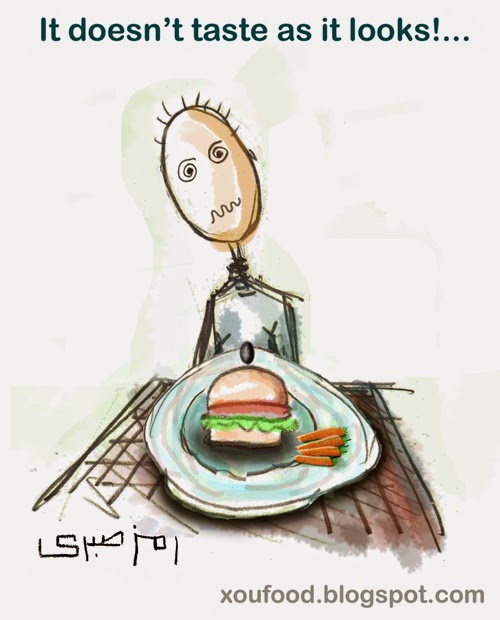
3- Don’t let only your eyes eat...

Pictures are most of the time the greatest mean of deception in a dining experience.
Do not order based on the images you see… Many restaurants will not serve you what you see in the picture because: it is not theirs!
And worse, sometimes it is made by them but they shoot only the "Menu" version  of the dish, while they serve you the "Customer" version of the dish.
When the pictures seem too professional, 
ask yourself: “Does this restaurant look like it can afford a professional food photographer to shoot their dishes for the menu?” and if they do "Do the customer orders around me, look like anything of what I see in the menu pictures?".
I know a fancy boat with many restaurants in Zamalek that literally steals images from the Internet and claims they are theirs on their official Facebook page. It happens widely!

4- Did they really write that!?...
Believe it or not, I have seen menus with spelling mistakes, in dishes names, ingredients names and cooking styles names. If they do not know what they are talking about, how would they know how to make it good!?

5- Know where you are before ordering...
I do not mind a restaurant with a cosmopolitan menu or chef signature dishes.
However, a restaurant with specific cuisine will most probably be good only in this cuisine’s dishes.
If you are in the mood for pasta with a creamy white sauce, do not go to an oriental grill restaurant to order it! Or if you insist, do not expect it to be as good as that one you love at that French or Italian restaurant.
Do not waste your money ordering wrong dishes in the wrong place.

Continue reading part 2 here...
Special thanks to...
Art work by: Ramz Sabry Samy


www.xoufood.com
www.facebook.com/xoufood